

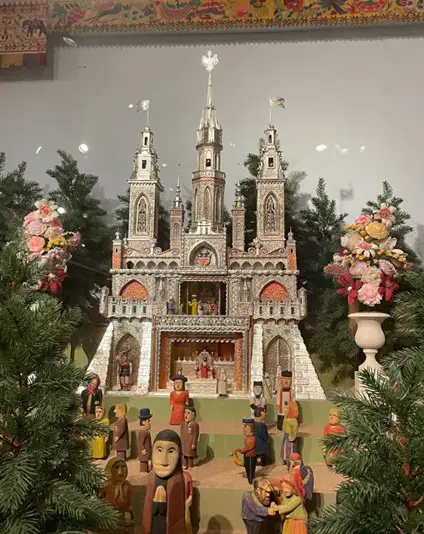
When you visit the Museum of International Folk Art, you will come across our exhibit, Multiple Visions: A Common Bond, located in the Girard Wing.
It holds a folk art collection assembled by Alexander Girard, a renowned architect and designer known for his brilliant work and an impressive collection of folk art. With the help of his wife, Susan Girard, they were able to curate an exhibit with 10,000 objects to look at. Inside, you will see many colorful and beautifully odd works of art, different from your typical art museum. These works of art were created by people from around the globe, over many decades.
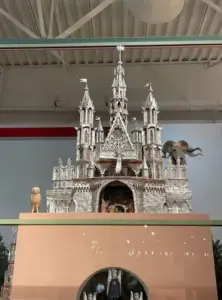 Then, as you continue to peruse the exhibit, you'll find yourself being towered over by a huge, delicate, and intimidating metal chapel. Well, that's your perspective of it, after witnessing the other miniature displays in the Girard Wing, anyway. What you are witnessing is a Christmas Crib nativity — originating in Kraków, Poland — called szopka Krakowska (shop-KA kra-KOFF-ska). Each resembles specific Catholic historical buildings within Kraków, like the famous St. Mary's Basilica.
These beautifully assembled chapels are most often created with recycled materials, like cardboard, and the tin foil from gum wrappers or cigarette packaging. Some szopka-making families save up on these materials all year. Folk art as a whole encourages people to make art with what they have or collect within their communities, which is the reason why Kraków Christmas cribs are one of the most important traditions within Poland's folk art and Christmas arts. It's no wonder that Girard gathered them here at MOIFA, along with many other Polish figures and art pieces.
One of the biggest szopki displayed in the museum was made by Zygmunt Grabarski, a wonderful artist with a knack for making nativities such as this one, in the 1960s–70s. He built many szopki over the course of 18 years, building some that were over 25 feet tall, and others under just a few inches tall. He won 12 different times in Kraków's yearly competition, and got 2nd place 4 times. Most of his pieces are now in museums including those in Poland, France, Canada, and the United States, especially this szopka (pictured on the right) at MOIFA. This specific szopka was made around 1965, and before 1980 was placed in our permanent exhibit alongside another szopka by an unknown artist.
Kraków nativities were traditionally used alongside puppets and dolls to tell a story associated with Catholic Christmas. Girard assembled a marvelous story in the exhibit display highlighting the first star seen on Christmas, various Polish Christmas suppers, and Christmas festivities all through this static art, bringing a still scene to life that pays tribute to the chief principles of szopka Krakowska.
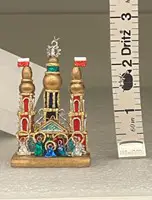
A contemporary szopka artist who came to New Mexico through the International Folk Art Market (IFAM), Marzena Dłużniewska is one of the only female professional szopki makers in Poland. There are an estimated 40 professional szopka makers in Poland according to Dłużniewska, and only a few of them are women. Some of her works are in our collections at MOIFA and featured at our hands-on activities. This piece pictured here is just barely above 2 inches tall, and is one of our smallest szopki in the collection. One of her pieces was even bought by Netflix in 2019 to be displayed as a background piece in the movie Christmas Chronicles 2.
History
 Szopki are known as far back as the 13th century in Poland, often being utilized for glamorous street performances and carolling as a backdrop to marvelous static figurine actors, and later with marionettes and stringed puppets. These performances occurred around Christmas time and portrayed religious stories like the birth of Christ. This form of traditional Catholic storytelling originated in Italy under St. Francis of Assisi and was later brought to Poland as a result of various religious exchanges between the two countries. As this tradition grew, some performances began to be more satirical, especially in the 18th century with the controversial politics of the day. This prompted political figures (i.e. bishops or people in the clergy class) to ban such colorful and insubordinate performances. However, like all traditions around the world, they came back, continuing to persevere through the highs and lows of popularity and taboo.
In 19th-century Poland, the Christmas Crib nativities had their first comeback, with construction workers looking for jobs in the dead of winter. They decided to make szopki out of recycled construction materials, like wood and tin. Szopki began to become popular again, and were built to massive sizes, in gorgeous colors, and used heavily by paid carolling groups.
It wasn’t until World War I that szopki were, once again, banned. Along with the ban and the time needed for gathering materials, the szopiki was quickly renderedunimportant to citizens due to the bigger problems they had to deal with during the war. The tradition was almost forgotten until 1937 when a national competition arose that encouraged citizens to make szopki from the comforts of their communities and compete for grand prizes (most notably money and pastries, which was a huge prize considering the onset of the Worldwide Depression). This revived the tradition - took Krakow by storm, encouraging locals to participate in their communities' history with beautifully crafted folk art. Aside from the Nazi occupation of Poland during World War II in 1939, when they had to stop the competition until December 21st, 1945- the tradition once restarted has continued with strength. As of today, the competition is still ongoing, and is now more than 80 years old.
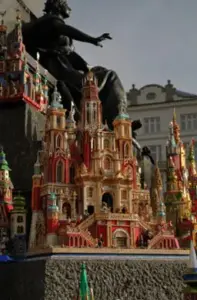
Today, locals will meet at the Adam Mickiewicz statue in the Grand Square of Krakow. This monument memorializes Mickiewicz, who is considered one of Poland's best romantic poets and a political rights activist in the 19th century. The competition embarks on the first Thursday of December, and it's traditional for citizens to explore the local churches and chapels and see the szopki they have set up for Christmas inside. Artists bringing their szopki for the competition will also have a chance to admire each other's work, until they all have to gather up and disappear for the judges to deliberate on the winners of the competition. As for the grand prize, winners will be granted the opportunity to be in the Historical Museum of the City of Krakow along with all of the past years winners of the competition. Folk music ensues from local bands and plays following the contestant's absence, which brings together the tradition as the competition slowly concludes.
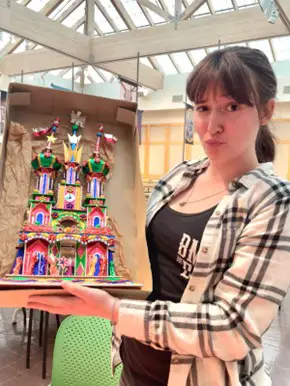
Intern Statement
Szopkas truly spoke out to me, as they were so unique and they impressed me more than any of the other pieces within this exhibit. It was always a special moment whenever I got to handle a szopka, regardless if it was a few feet tall or a few inches big. Seeing the intricacy within each piece astounded me, the skill behind each structure, or the beautiful colors specifically chosen to be combined together, everything about szopki astounded me. I just knew I had to write about it for my blog. Ever since I started interning here at the museum, I've been learning nonstop about so many different cultures, and being able to lead my own research project about this wonderfully niche tradition has been one of the best parts of my time working here.
Here's a look at our in-house szopki and a DIY szopki project you can make at home!
By Brenna Weaver, MOIFA Education Summer Intern 2024, and local high school student.
Bibliography
- Nagroda Kolberg — Zygmunt Grabarski
- Folk Art Market — Artist Stories
- The Marvellous Christmas Tradition of Poland's Szopki — Culture.pl
- Adam Mickiewicz — Culture.pl
- 8 Christmassy Paintings from Poland — Culture.pl
- Nativity Scene (Szopka) Tradition in Kraków — UNESCO
- Kraków's Szopki: Poland's Wonderfully Exuberant Christmas Tradition — Kafka's Desk
- Nativity Scene Szopka Tradition — Living Heritage Journeys
- The Christmas Tradition of Kraków Szopka — PAC Wisconsin
- Szopka Krakowska — SITE Santa Fe