

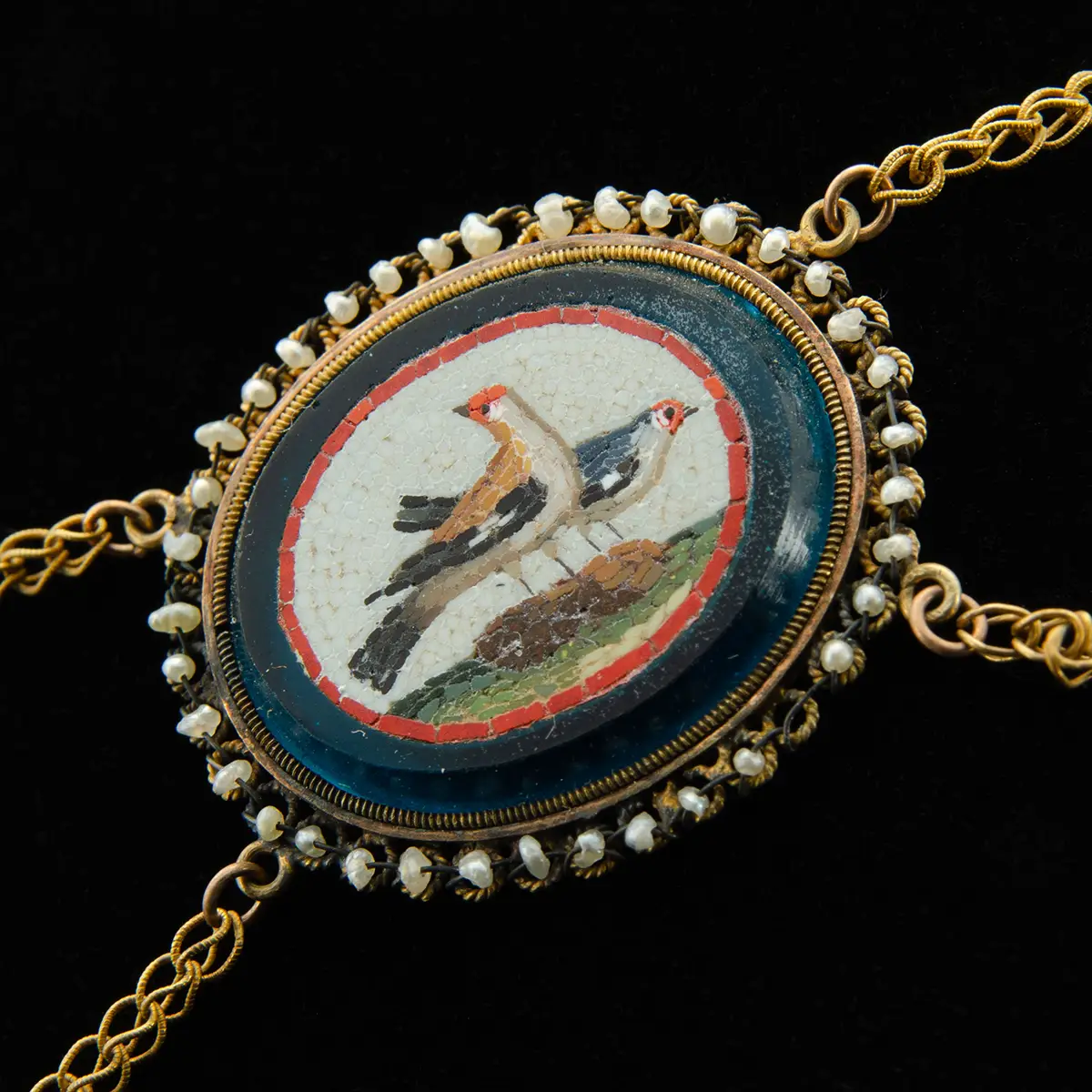
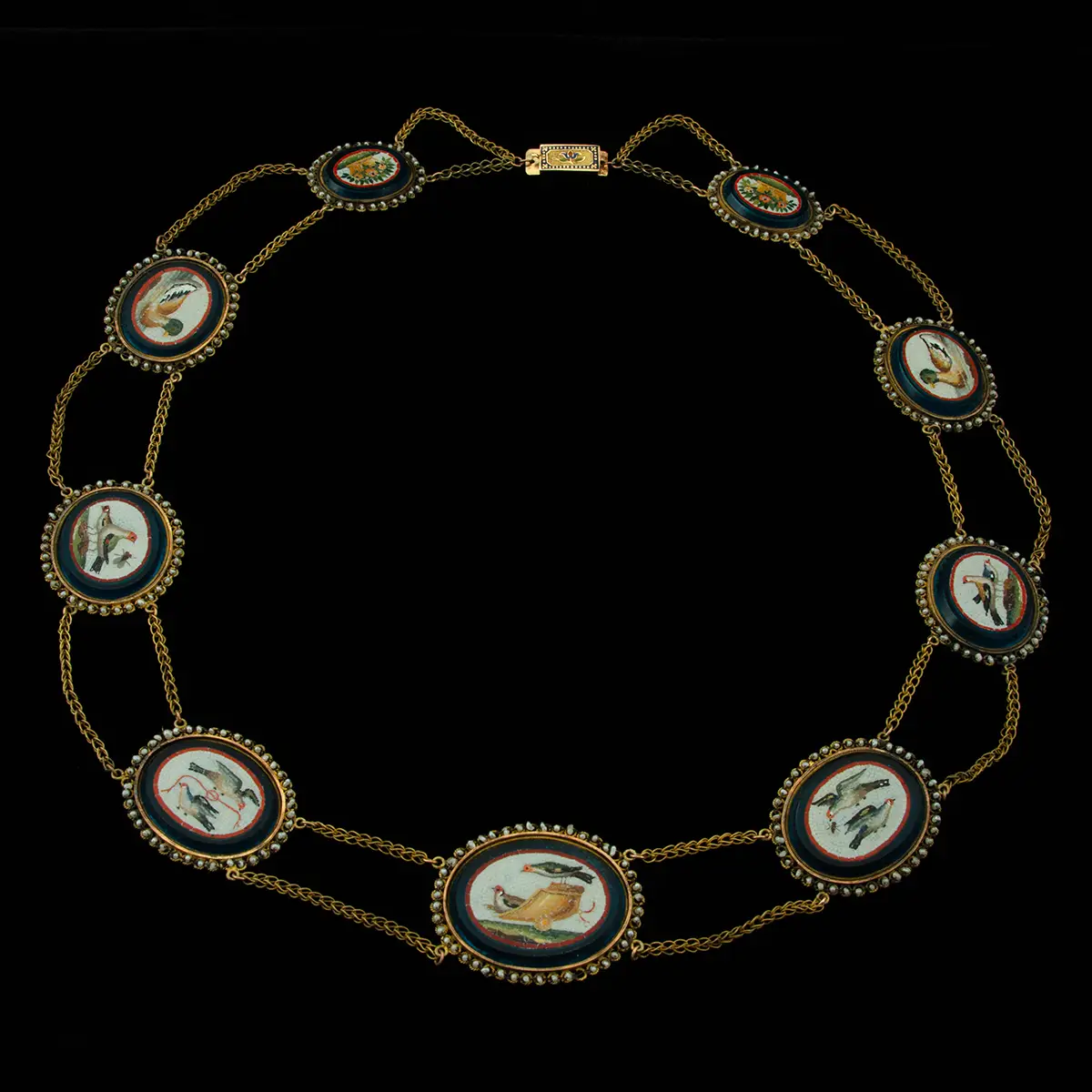
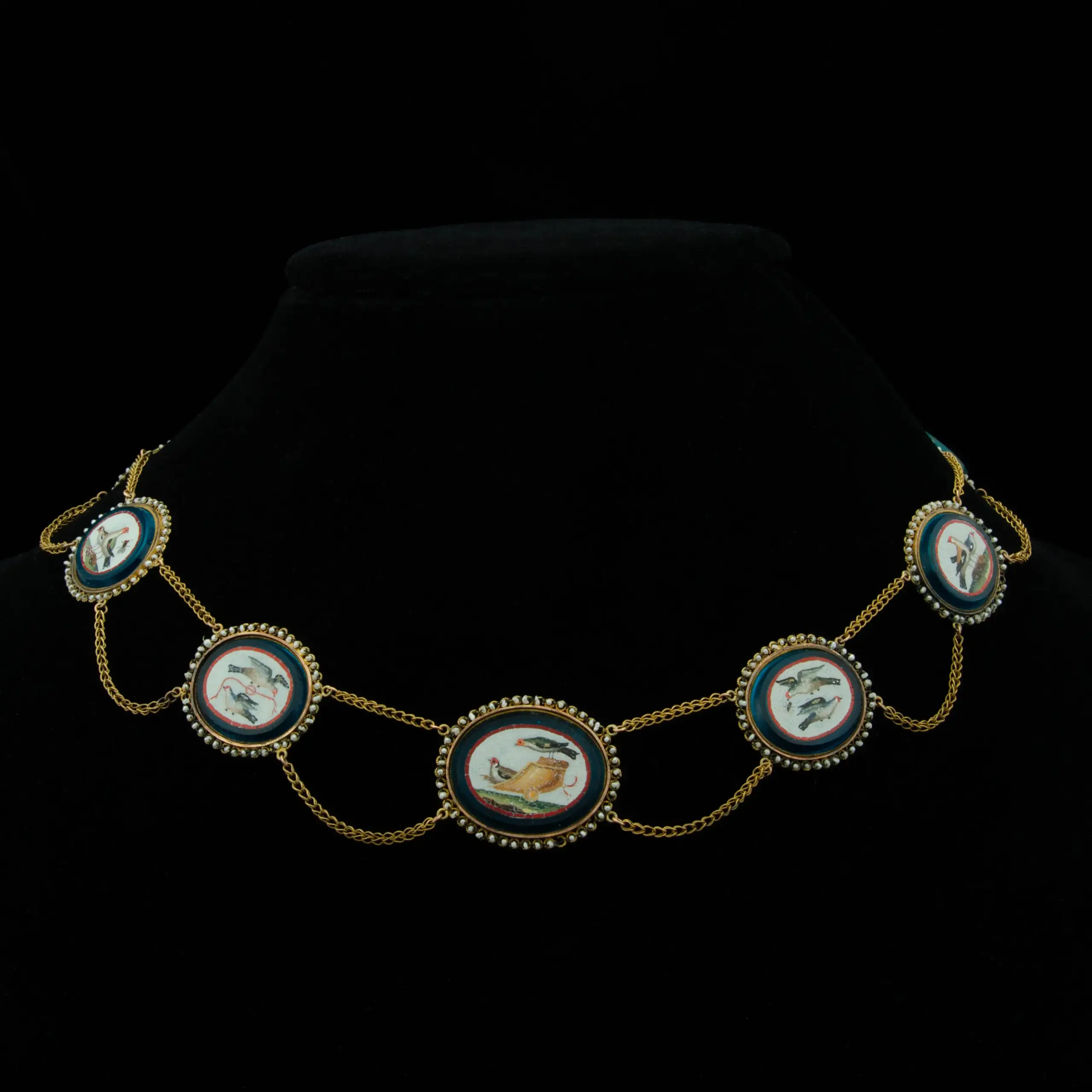
This exquisite18th century Italian necklace is composed of nine ovals in gradated sizes, backed by blue glass and surrounded by seed pearls. Gift of Florence Dibell Bartlett: A.1955.86.769a-e Necklace (a): doubled length: 8-3/4″
This extraordinary jewelry set, composed of a necklace, a pair of earrings and a ring, all resting snugly inside of its original elegant ivory-satin-lined case was donated by Florence Dibell Bartlett the founder of the Museum of International Folk Art.
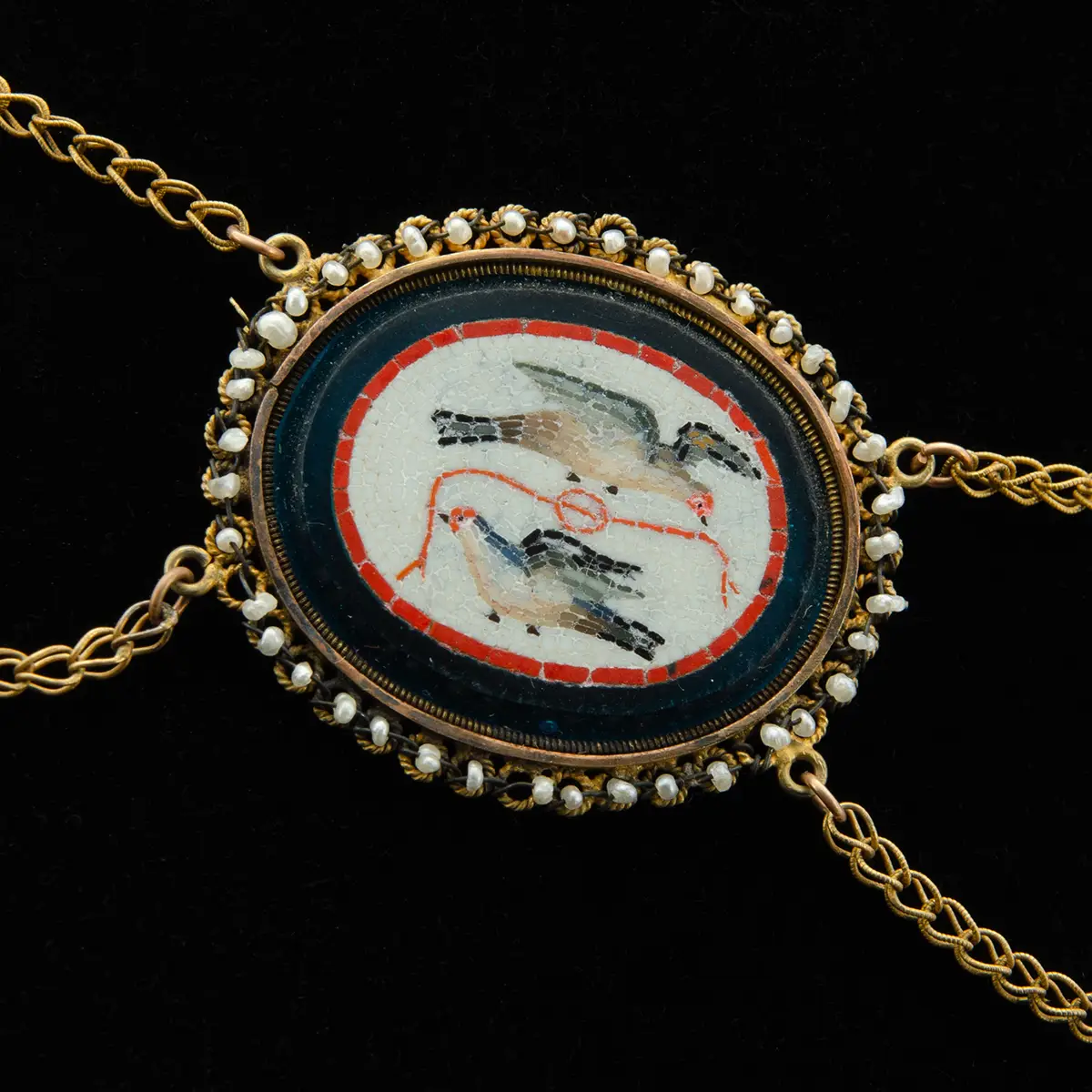
Meticulously fashioned out of tiny and vividly colored glass and enamel mosaic pieces (tessarae), this exquisite 18th century Italian necklace is composed of nine ovals in gradated sizes, backed by blue glass and surrounded by seed pearls. They are all joined by a double strand of gold filigree wire chain, fastened with a rectangular clasp that is decorated with an enameled tulip motif.
Each of the ovals contains a charming vignette depicting miniscule images of either singular or pairs of birds — including gulls (possibly catching a worm, or a strand of seaweed, or perhaps a branch of red coral) and hapless flies, as well as a green-headed mallard duck, winged insects (a blue butterfly appears on the ring), and a basket of flowers surrounded by a spray of green leaves. The sections of the earrings display a pair of nesting birds in the lower segments, with a small fly in the upper ovals, both joined by a gold wire bow.
Photos by Pennie McBride. Museum of International Folk Art, gift of Florence Dibell Bartlett, A.1955.86.769a
To create such minute and delicate masterpieces, lengths of glass rods (smalti filati) are melted at high heat and extended into tubular canes, which are then cut into minute pieces. These nearly microscopic segments of glass are placed with tweezers into a soft adhesive within the framework and the base, which is made of either metal, glass or porcelain; then pressed down to arrange the mosaic scenes. Finally, the surface is finished by polishing, to secure, seal and preserve it.
The fascinating tradition of mosaic decorations as murals and floor ‘carpets’ dates to ancient Roman times, with roots in the Classical architectural heritage of Italy. During the Renaissance through the 18th century, this was a thriving industry, particularly in Florence and Rome, where it was primarily dedicated to church adornment, most notably for the Vatican’s St, Peter’s basilica.
Michelangelo Buonarroti, the renowned artist and genius of many well-known works of art, even wrote admiringly about this art form: “Mosaic is the art of uniting small stones to create a work of art that otherwise, would be impossible.(1)
But after the era of large mosacis was winding down, with diminishing opportunities for work for the official church or private homes’ mural commissions, the artisans had to seek other work. The artisans did so through developing a side business, creating miniature and more portable and wearable versions to sell to private customers or traveling visitors — depicting famous historical ruins, pastoral scenes, devotional religious iconography and picturesque images of flora and fauna.
This tradition evolved into the “micro-mosaic” souvenir jewelry business that remains popular with collectors today — largely based in Venice and on the nearby glass manufacturing island of Murano — where an array of necklaces, bracelets, brooches and rings is produced with the astonishing precision and exceptional craftsmanship that is the hallmark of this genre. Florence has also been a center of production, blending its precision goldsmithing techniques with the similar skills required to create “Pietra Dura” (precious stones and gems) inlay work.
Photos by Pennie McBride. Museum of International Folk Art, gift of Florence Dibell Bartlett, A.1955.86.769a
Photos by Pennie McBride. Museum of International Folk Art, gift of Florence Dibell Bartlett, A.1955.86.769a
The founding “father” of the new craft, credited with initially developing this type of jewelry was Giacomo Raffaelli who held an exhibit at his studio in Rome in 1775. His pieces featured naturalistic scenes of ancient ruins, religious subjects and scenes based on Old Master paintings. He was commissioned in 1806 by Napoleon the First to recreate a miniature version of Leonardo DaVinci’s “Last Supper”, which took him eight years to complete; but by then the Emperor had abdicated, and it was later installed in the Minoriten Church in Vienna, Austria. (2)
During the late 18th to 19th centuries, European nobility and Victorian era foreigners often embarked on what was considered to be a “rite of passage” as an educationally cultural journey known as the “Grand Tour. This tour routinely ended in Italy, where these tourists admired Roman and Renaissance arts and monuments, then wanting to take home a tangible memento as a precious and pocket-sized souvenir of that prestigious journey. Even fine “vintage” pieces from the 1920’s though the 1970’s, featuring bolder colors, less intricate designs, and larger tessarae are still prized and highly valued.
By Tamara Hill, MOIFA staff
Selected Sources
- From: https://www.devilsdetailsboutique.com/blogs/how-to-style-vintage/history-of-vintage-italian-micro-mosaic-jewelry
- From: https://www.eredijovon.com/en/
Other general reference: Roberts, Claire. June 12, 2022: https://www.thejewelleryeditor.com/jewellery/know-how/all-you-need-to-know-about-the-history-of-micro-mosaics-a-unique-artistic-tradition-born-italy-and-still-trending-today-sicisjewels/ [accessed on 1/7/25]
Visit
Plan your visit to the Museum of International Folk Art
Learn
Teaching resources, research fellowships, and resources from our library and archives
About
Learn more about MOIFA and our mission
Explore
View our various exhibitions and collections
Support
Learn how you can support the museum and our efforts.