

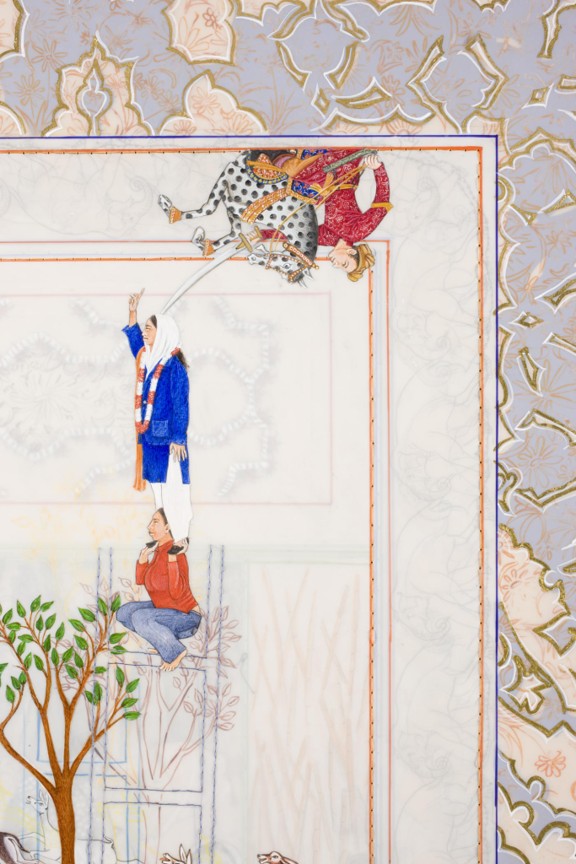
Ambreen Butt, close up of The Great Hunt II, from the series Dirty Pretty, 2008. Water‑based pigments, white gouache, thread, and gold leaf on layers of Mylar and tea‑stained paper.
Truth Be Told: Artists Activate Tradition is an exhibition which opened in January of 2026 and upon my first viewing of the exhibition I was immediately struck by The Great Hunt II by Ambreen Butt. I was drawn to it because it had elements of traditional South Asian art in it, namely the Indian and Pakistani miniature painting, a region and genre of art that greatly interests me. The purpose of the exhibition is to highlight “a dozen international artists who engage with folk traditions from their respective communities in order to critique social inequities, reverse erasure, and be a catalyst for social change.”
Like all of the art in Truths Be Told: Artists Activate Tradition exhibition, Ambreen Butt’s pieces are undeniably political. When one enters into the exhibition and turns left, there stands her two-piece painting titled The Great Hunt II from the Dirty Pretty series (ca. 2008). In this exhibition, there are two other pieces from Ambreen Butt presented: The Great Hunt I, also from the Dirty Pretty series, and Soul of my Soul from the I Bear Witness series. Both amazing in their own right, and very moving, especially the Soul of my Soul piece, since it is a collage of quotes from George Floyd and a Palestinian grandfather who has just lost his family in a drone-strike.
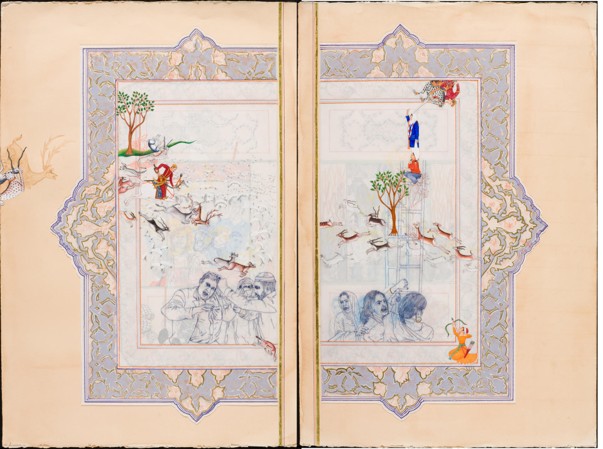
Ambreen Butt, The Great Hunt II, from the series Dirty Pretty, 2008. Water‑based pigments, white gouache, thread, and gold leaf on layers of Mylar and tea‑stained paper.
Ambreen Butt is a Pakistani American artist who was born in Lahore, Pakistan. She received her BFA in “traditional Indian and Persian miniature painting” at the National College of Arts in Lahore in 1993. Afterwards, she moved to Boston and received her MFA in painting from the Massachusetts College of Art and Design in 1997. She now resides in Dallas, Texas, and is the recipient of multiple domestic and international grants and awards. Her works have been featured in multiple galleries and museums, as well as private collections all around the world. She was the artist in residence at the Isabella Stewart Gardner Museum in Boston, where her work is described as addressing “themes of war, violence, and oppression, as well as more private concerns of identity, desire, and awakening.” In her own words she says, “I see the world through the lens of a woman and a mother.“
Upon closer observation, I was very pleasantly surprised how one can look at it for hours and continue finding new little details. The piece appears to open like a book, with a middle division acting like a page break. The borders also look like the edges of the book, but one may notice there is a scene of a leopard eating an antelope outside of the borders on the left side of the left piece.
On both sides of the piece, one may also notice the multiple drawn figures of people and animals which form hunting scenes inspired by the Akbarnama, a 17th century biography of the Mughal emperor Akbar. It is one of the classics of South Asian literature. Those small hunting scenes appear to be self-contained, and do not interact with the other painted hunting scenes. On the left side there is a mounted archer giving chase to a few deer, who run away in a crescent-like shape to the bottom right side of the piece, ending with a dead deer. On the right side, there is a herd of deer along the middle of the piece, who are running away from an archer, who is seated in the bottom right corner. On the top right side and corner of the right piece there is a painted scene of three figures: a woman who stands on the shoulders of another, as well as a rider with a sword that points directly at the head of the woman standing.
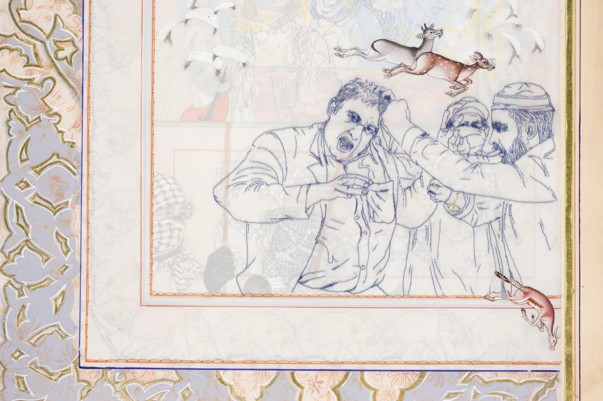
Ambreen Butt, close up of The Great Hunt II, from the series Dirty Pretty, 2008. Water‑based pigments, white gouache, thread, and gold leaf on layers of Mylar and tea‑stained paper.
Upon further observation one will notice that there are multiple layers to this piece, physically and metaphorically. Starting at the base layer is tea-stained paper, traditionally called Wasli, Stitched onto this paper is a layer of mylar, upon and under which the majority of the subjects of the piece are present. Stitched into and under the mylar are multiple modern scenes of people who are fighting and arguing. In contrast to the painted and colorful classical figures, the modern scenes are stitched in an abstract way and generally devoid of color. I am curious though why the artist added painted gold jewellery to the stitched-on figures. Content wise, the classical and modern scenes are different as well. The classical paintings represent the hunt, and all though violent by nature, they are in contrast to the modern scenes of political violence that Pakistan faced in 2007 when the country went through a constitutional crisis.
If one observes both the classical and the modern scenes, a certain unity formed by the two can be noticed. On the left side, the composition goes from top left to bottom right corners, starting at a tree and moving down the crescent that I mentioned earlier, one sees the hunter, the deer and scenes of modern political violence, ending in a dead deer at the bottom right corner of the piece. On the right piece, the composition is a simpler line that can be traced along the stitched-in ladder. It begins in the scene of the women arguing and fighting with each other at the bottom of the piece, moving up the ladder we encounter the herd of deer and above them, at the top of the ladder we encounter the woman standing on the shoulders of the other woman with a sword pointed at her head. Ambreen Butt endorses the interpretation of her work that the woman standing on the shoulders is Benazir Bhutto, and the sword pointed at her head is a symbol of her assassination. Benazir Bhutto was the first female Prime Minister of any Muslim nation and was assassinated in Pakistan at the end of 2007 by a shooting and a suicide bombing. One may notice that both the Benazir Bhutto figure and the woman that is supporting her have the same face. This repetition serves as a symbol of kinship and sympathy with the women of Pakistan. A gesture showing that “we can be both the woman standing and the woman who supports.” I wonder what the artist is trying to say in regard to the sword pointed at Bhutto’s head by a classical image of the Mughal warrior. Is it speaking to the tradition and customs of society that killed Benazir Bhutto? And yet both women are also drawn in the classic style. Are they the answer to the problem posed by the warrior? I suspect so.
The mixing of the traditional miniature paintings along with the stitched in modern scenes of modern violence are a fascinating image. The modern violence is literally stitched into the scene, it is violently permeating the sheet of mylar upon which the hunt is taking place. It is also stitched under the sheet of mylar so that the viewer may see it, although faded and not yet present on the surface like the other scenes of violence.
I will leave you with those questions to ponder while appreciating this artwork, and a pleasant detail: be sure to find the elephants that are drawn on the borders of both the left and right pieces.
By Oliver Hansen, MOIFA Education Intern and St John’s College Student
Bibliography:
- https://www.moifa.org/?q=exhibitions/exhibition-details&eventID=6423
- https://ambreenbutt.com/biography/
- https://www.gardnermuseum.org/experience/contemporary-art/artists/butt-ambreen
- https://www.eveandmax.com/blogs/conversations/in-conversation-with-ambreen-butt?srsltid=AfmBOoqNVqtXIBypOsOPowr6jz3jLeVPVF-ewvLTaBB-EY1nTHCJj3Fo
- https://ambreenbutt.com/projects/dirty-pretty/
- https://www.theguardian.com/world/2007/may/13/pakistan.peterbeaumont
- https://www.instagram.com/p/C1YNScFNvuf/?hl=en&img_index=1
- http://news.bbc.co.uk/2/hi/south_asia/7161590.stm
- All photos are from Ambreen Butt’s website. https://ambreenbutt.com/projects/dirty-pretty/